Multi-Purpose Dynamic
Simulators (MPDS)
Simulate, predict, and optimize processes throughout the plant lifecycle, from Design to Operations by using the investment in an Operator Training Simulator (OTS) to improve & de-risk project execution and ensure Operational Excellence from Day 1 of operation.

The Multi-Purpose Dynamic Simulator (MPDS) is a groundbreaking concept that leverages dynamic process simulation by extending the application of dynamic process modelling across process design, commissioning, and operational phasesproposes the use of dynamic simulation models all along the whole processing plant lifecycle, leveraging the invested modelling effort.
Traditionally, dynamic process models have been used independently during engineering phases and later on for operator training prior to commissioning – as part of an Operator Training Simulator (OTS). Often, in engineering projects, the dynamic process models are siloed for specific uses. However, the MPDS methodology integrates and reuses these models throughout the project lifecycle, the models are used for a variety of extra applications, delivering additional benefits from the investment in the OTS.
In Inprocess’ MPDS methodology, dynamic process models serve as the backbone of the engineering project, supporting various stages and evolving alongside the process lifecycle. Acting as a living repository of process knowledge, these models provide continuity and insight across design, commissioning, and operational phases. Such a methodology ensures that the process model is not just a tool but a central asset to support the engineering and operation of the process.
Several are the Inprocess’ Services that can be associated to the availability of a Dynamic Simulation Model. For instance:
Services and Phases of a Multi-Purpose Dynamic Simulator project

Phase 1: Process Verification
The foundation of MPDS begins with the creation of rigorous dynamic process simulation models. Using first principles-based simulation tools and engineering data, this phase focuses on verifying design feasibility and enhancing control philosophies. Typical activities include:
- Validating design alternatives.
- Verifying equipment protection and capacity considering the potential transient peaks.
- Optimizing equipment such as compressors, pumps, and buffer vessels.
- Enhancing safety systems and transient response mechanisms.
This phase establishes a number of reliable equipment process models that evolve in subsequent stages.
Phase 2: Control and Safety Verification
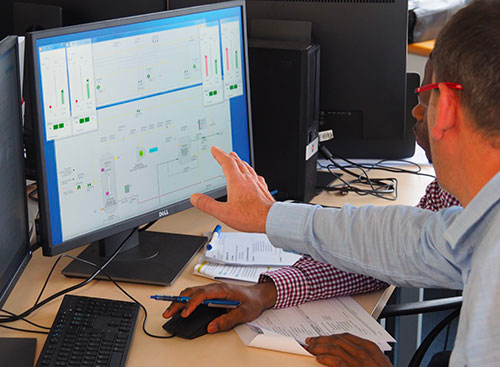
Building upon Phase 1 and combining the different equipment models into a single process unit model, this stage incorporates control narratives, safety interlocks, and cause-and-effect matrices (C&EM). Known as the Safety Test Simulator (STS), this phase is crucial for:
- Testing regulatory controls and safety systems.
- Validating operating procedures, alarms, and interlocks.
- Refining startup, shutdown, and emergency protocols.
Dynamic modeling in this phase enables engineers to identify gaps early, reducing risks during future plant commissioning.

Phase 3: Early Process Trainer
With the integration of Human-Machine Interfaces (HMI) and instructor tools to the current dynamic process unit model, the MPDS is transformed into an Early/Emulated Operator Training Simulator (OTS). This tool allows operators to:
- Gain process familiarity.
- Practice scenarios such as start-up, shutdown, and emergency responses.
- Enhance understanding of process behaviors and limits.
Training at this stage accelerates the learning curve for operators, ensuring that operators begin to be prepared well before the plant startup.

Phase 4: DCS and SIS Checkout – Virtual Commissioning
Once the Distributed Control System (DCS) and Safety Integrated System (SIS) databases are available from their vendors, Virtual Commissioning is conducted. This activity is usually an iterative process where Inprocess tests and validates more than one version of the databases, while the vendors keep updating them until approved. Known as the Automation Test Simulator (ATS), this phase:
- Risk Mitigation and Safety Assurance
- Enhanced Control Logic and Strategy Optimization
- Realistic Scenario Testing
- Minimized Downtime and Production Interruptions
- Control System Performance Validation
Virtual Commissioning with MPDS can eliminate most of the DCS and SIS programming errors prior to real-plant commissioning, significantly reducing the risk of commissioning.
Phase 5: Operator Training Simulator (OTS)
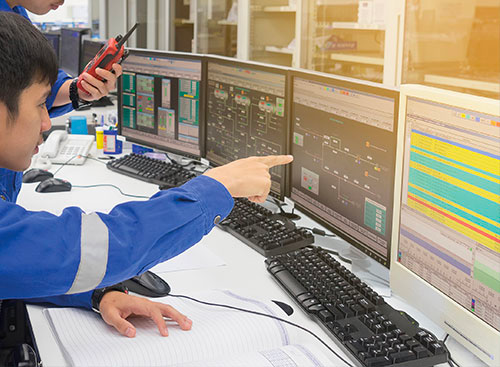
A fully integrated OTS is developed by incorporating in this phase the finalized DCS and SIS versions. This Direct-Connect OTS (DC-OTS) mirrors the real control and safety environments, enabling operators to be trained in:
- Performing unfamiliar tasks safely.
- Responding to abnormal scenarios and emergencies.
- Developing proficiency in complex automated systems
Continuous training with OTS increases the confidence of the operators, minimizes human errors and delivers operational excellence.

Phase 6: Supporting Plant/Unit Startup
During the initial plant startup, MPDS serves as a critical troubleshooting tool. By replicating expected plant conditions, it helps to:
- Address issues promptly.
- Reduce ICSS vendor reliance during commissioning.
- Ensure smoother, faster startup processes
Inprocess teams can provide on-site support, leveraging their deep knowledge of the plant acquired during MPDS development.

Phase 7a: Operational Support (offline)
Once the processing plant is operational, the MPDS evolves into a Process Digital Twin by incorporating final “as-built” data. Now the process model(s) can be used for ongoing support for operations and maintenance activities. These include:
- dynamic analysis for any new equipment design and sizing,
- flare system revalidation,
- process debottlenecking,
- and control studies to refine loop configurations or validate inferred process values.
It also aids operational studies e.g., to analyze alternative feedstocks, mitigate plant issues, or explore more profitable and sustainable operating strategies.

Phase 7b: Operational Support (online)
When connected online to the plant’s instrumentation and historian database, the MPDS transforms into an Online Digital Twin/Real-Time Simulator, significantly expanding its utility. It enables real-time performance monitoring of critical equipment, predictive maintenance, and faster what-if scenario evaluations to preempt potential issues.
Operators and engineers can use the Online Digital Twin for informed decision-making, offering real-time advice and insights into process adjustments without disrupting actual plant operations. This integration also supports post-incident analysis, allowing engineers to restore past plant conditions for detailed examination and improved incident management protocols.